
New Mexico Wildlife Sightings & Interactive Map
Explore wildlife activity throughout New Mexico. From desert canyons, high mesas, and the Sangre de Cristo peaks, the state is home to bears, mountain lions and bobcats, coyotes, foxes, and wolves and much more. Discover community-reported sightings, interactions, and animal encounters while learning more about the wildlife that shares this beautiful state.
Return to map0 reports shown on the New Mexico map
New Mexico wildlife at a glance
These statistics reflect Wildlife Sentry community reports only and do not necessarily reflect total wildlife populations or actual regional risk.
Recent Wildlife Activity in New Mexico
No wildlife reports have been submitted for this state yet. Help our community grow by sharing your wildlife observations.
Report a Wildlife SightingDiscover Wildlife in New Mexico
Species known to live in or seasonally visit New Mexico. Being native to the state does not mean an animal has recently been reported through Wildlife Sentry.
Vulture
Cathartes aura
Habitat: Open country and roadsides across the Americas.
Turkey vultures and black vultures — nature's cleanup crew, riding thermals on 6-foot wings.
Osprey
Pandion haliaetus
Habitat: Coastlines, lakes, and rivers worldwide; big stick nests on poles and channel markers.
The 'fish hawk' — a specialist raptor that plunges feet-first into water for live fish.

Owl
Strigiformes
Habitat: Forests, deserts, and suburbs across the Americas; roosts in dense trees by day.
Silent nocturnal raptors — great horned owls can turn their heads 270 degrees and crush prey with powerful talons.
Falcon
Falco peregrinus
Habitat: Cliffs, tall buildings, and bridges; found on every continent except Antarctica.
The peregrine falcon — the fastest animal on Earth, diving at over 200 mph to strike prey midair.
Hawk
Buteo
Habitat: Everywhere in North America — open country, suburbs, deserts, and forests.
Broad-winged raptors like the red-tailed hawk, often seen circling on thermals or perched on roadside poles.
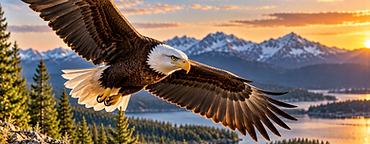
Eagle
Haliaeetus leucocephalus
Habitat: Near lakes, rivers, and coasts across North America; nests in tall trees near water.
The bald eagle, America's iconic raptor, with a 7-foot wingspan and piercing yellow beak.

Python
Python bivittatus
Habitat: Native to Southeast Asia; established in South Florida marshes and wetlands.
Large constrictors — the Burmese python is famous as an invasive giant in the Florida Everglades.
Copperhead
Agkistrodon contortrix
Habitat: Forests and rocky hillsides of the eastern US — often suburban trails and woodpiles.
A chestnut-brown, banded pit viper whose camouflage hides it perfectly in leaf litter.
Cottonmouth
Agkistrodon piscivorus
Habitat: Swamps, slow streams, and lake edges across the Southeast — often in or right beside water.
A semi-aquatic pit viper that gapes its white-lined mouth as a warning when cornered.
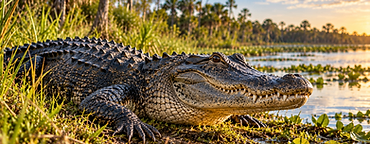
Alligator
Alligator mississippiensis
Habitat: Freshwater — Florida, Louisiana, and Gulf Coast swamps, lakes, golf-course ponds, and canals.
A dark, broad-snouted crocodilian up to 14 feet long, iconic to the American Southeast.
Crocodile
Crocodylus acutus
Habitat: Brackish and salt coastal waters of South Florida, the Caribbean, Mexico, and Central America.
A large, gray-green crocodilian with a pointed snout, found in the Americas. More aggressive than its alligator cousin.

Pig/Boar
Sus scrofa
Habitat: Forests, swamps, and farmland — especially Texas, Florida, and the Southeast.
Wild pigs and feral hogs — bristly, tusked descendants of domestic stock — invasive across much of the US.
Wildlife Safety Tips for New Mexico
Bear
Black, grizzly, and brown bears.
Carry EPA-approved bear spray where recommended and permitted, keep it immediately accessible, and know how to use it. Never approach or feed a bear. Don't run from a bear. Secure food, garbage, toiletries, pet food, and other scented items properly. Keep a clean campsite and never store food in your tent.
Remember: Keeping human food away from bears protects people and bears.
Big Cats
Mountain lions, cougars, pumas and other large cats
Stay alert when hiking, particularly around dawn and dusk. Keep children close and pets controlled. Never approach a big cat or its young. If you encounter a mountain lion, do not run. Face it, stand tall, make yourself appear larger, and give it an escape route. If attacked, fight back.
Remember: Awareness and distance can prevent an encounter from becoming a conflict.
Canines
Coyotes, wolves, foxes and other wild canines
Never feed or approach wild canines. Keep pets close and under control, and don't leave pet food, human food, or garbage outside. If a large wild canine approaches too closely, don't run; make yourself appear larger and use a firm voice while giving it room to leave.
Remember: Don't teach wild animals that people are a source of food.